KnowledgeBase
Your Guide To Automatic Door Servicing Requirements Under EN 16005
Automatic Door Servicing Requirements Under EN 16005: A Practical Compliance Guide for Building Owners, Specifiers and Facilities Teams
Automatic doors are often only noticed when something goes wrong – a door that doesn’t open cleanly, closes too quickly, or begins triggering unpredictably.
From a compliance perspective, however, automatic doors sit in a different category to most entrance products. They are powered systems incorporating safety devices, control logic, moving leaves and sensors – each presenting interaction risks. EN 16005 exists to ensure those risks are properly managed across the full lifecycle of the doorset.
If you’re an architect specifying entrances, a contractor handing over a project, or a facilities team responsible for maintaining a live building, the key principle is straightforward:
EN 16005 is not an “install and forget” standard. Safe operation relies on planned servicing, routine checks and proper documentation.
What EN 16005 covers (and why servicing is part of compliance)
EN 16005 applies to power operated pedestrian doorsets, including sliding, swing and revolving doors. It addresses safety across the lifetime of the installation – not only operation, but also assembly, dismantling, disabling and end-of-life considerations.
This broader scope is important. It positions servicing and periodic checks as part of “safety in use”, rather than simple maintenance. In practical terms, this means considering:
- How users approach and pass through the door
- Foreseeable misuse (peak surges, trolleys, children, tailgating, wind exposure)
- System behaviour in the event of sensor failure or environmental change
- How safety devices are routinely checked and recorded
Who is responsible?
A common misunderstanding is that compliance rests solely with the installer. In practice, responsibilities are shared – and the owner/occupier has ongoing duties relating to risk assessment, inspection and record keeping.
Industry guidance consistently reinforces this point: doors should be maintained in accordance with the manufacturer’s instructions by suitably trained & Certified personnel, and the occupier must ensure the system remains safe in use.
For organisations operating across healthcare, education, hospitality, or commercial environments, automatic entrances should be treated in the same way as any other safety-critical system: planned servicing + routine checks + documented evidence.
What EN 16005 means in practice: servicing, checks and documentation
EN 16005 is a technical standard, but reputable industry and manufacturer guidance provides clarity on practical expectations.
1) Service the doors in accordance with manufacturer specification
Servicing frequency (to comply with EN16005 Automatic doors must be serviced at a minimum twice per annum) should reflect actual usage and environmental conditions, including:
- Traffic volume (secondary entrance vs main public entrance)
- Usage profile (trolleys, wheelchairs, deliveries)
- Environmental exposure (wind, coastal conditions, temperature fluctuation)
- Door type and safety device configuration
A commonly referenced baseline is at least annual servicing, with increased frequency for high-traffic environments. In many healthcare and retail settings, twice-yearly (twice no matter the environment) servicing is adopted due to consistently high footfall.
2) Carry out regular safety checks (and retain records)
One of the most effective compliance measures is consistent safety checking supported by clear record keeping.
Recent ADSA guidance includes downloadable check logs designed to assist occupiers in recording inspections and retaining documentation (with at least 12 months’ retention recommended). In practice, the question is rarely “was it maintained?” It is “can you demonstrate that it was maintained?”
3) Maintain a logbook or maintenance record
Owner and occupier responsibilities are consistently emphasised within guidance. Maintenance logs should be kept up to date and supported by risk assessment documentation where required.
A comprehensive log should include:
- Service dates and engineer/company details
- Tests undertaken (sensors, safety edges, presence detection, forces, opening speeds, hold-open times)
- Defects identified and actions taken
- Adjustments to settings and justification (particularly following incidents or layout changes)
- Callouts, breakdowns and parts replaced
- Identification codes of any new parts.
Clear documentation is central to defensible compliance.
Real-world scenarios: where compliance often falls short
In most cases, compliance issues do not arise from poor installation — they arise because the building changes and the servicing regime does not.
Scenario A: Increased traffic without review of servicing
A staff-only entrance becomes public-facing, or additional facilities increase overall footfall. What was once a low-frequency access point may become a primary circulation route. In these situations, automatic doors are often still operating to their original configuration and servicing schedule.
Over time this can lead to:
- Inconsistent sensor activation due to increased approach angles
- Hold-open times that are too short during peak flow
- Increased mechanical wear on operators and closers
- Higher likelihood of impact damage
- Premature degradation of safety devices
From a compliance perspective, the issue is not that the door “stops working” – it is that its performance no longer aligns with current usage risk.
An auditor or insurer reviewing the building would reasonably ask:
- Has servicing frequency been reassessed?
- Has performance been tested under peak traffic conditions?
- Is there documentation to evidence that review?

Action: Reassess servicing frequency and safety performance in line with updated usage patterns. This may include increasing service intervals, recalibrating sensor fields, adjusting hold-open timings, and documenting the revised risk assessment.
Automatic doors should respond to how the building is used today — not how it was used when originally installed.
Scenario B: Changing user profiles
Healthcare, hospitality and education environments often evolve over time. An entrance originally configured for standard pedestrian flow may begin accommodating:
- Hospital beds or stretchers
- Wheelchairs and mobility scooters
- Luggage carts or trolleys
- Cleaning equipment
- Large student groups during peak periods
While the door may still appear to operate normally, the interaction risk has changed. Sensor detection fields that were adequate for upright pedestrians may not fully cover lower or slower-moving equipment. Hold-open times may not allow safe clearance. Force settings may feel acceptable to one user group but not another.
In these situations, compliance risk is subtle rather than obvious. An incident does not need to occur for the system to be considered misaligned with EN 16005 expectations. The standard requires that foreseeable use – and foreseeable misuse – are considered.
An auditor reviewing such an environment would expect to see:
- Evidence that user profile changes were assessed
- Documentation of any sensor recalibration or adjustment
- Confirmation that safety devices were tested following modification
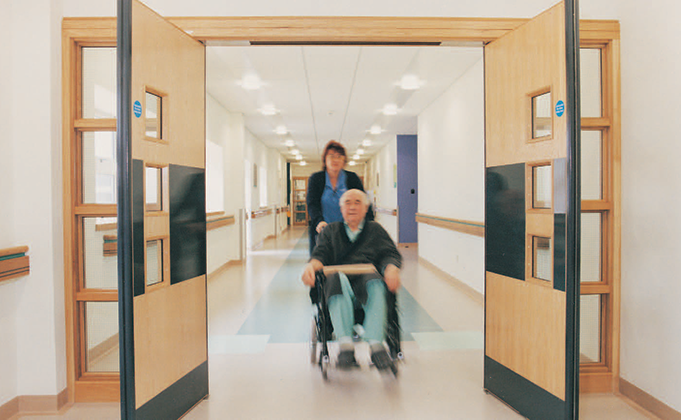
Action: Undertake a documented risk review when user types or usage patterns change. This may involve adjusting sensor fields, reviewing detection zones, modifying hold-open times, and validating force and safety performance in line with current operational realities. Automatic doors must be assessed against how they are actually used – not simply how they were originally intended to be used.
Scenario C: Environmental impact
Environmental factors are frequently underestimated in automatic door compliance. Changes such as these below can significantly affect door behaviour:
- Increased wind exposure
- Removal of draught lobbies
- Altered internal air pressure (stack effect)
- Seasonal temperature variation
- Coastal or high-humidity environments
Doors may begin to “hunt” in windy conditions, fail to close fully, reverse unexpectedly, or place additional strain on operators and safety components.
Importantly, these issues are often intermittent – appearing during certain weather conditions and then disappearing – which makes them easy to dismiss. However, EN 16005 requires that doors remain safe under foreseeable environmental conditions. If performance is being affected seasonally, servicing schedules and system settings should reflect that.
From a compliance perspective, the relevant questions become:
- Has environmental impact been considered within risk assessment?
- Are servicing intervals appropriate for the exposure level?
- Have force and safety settings been validated under adverse conditions?
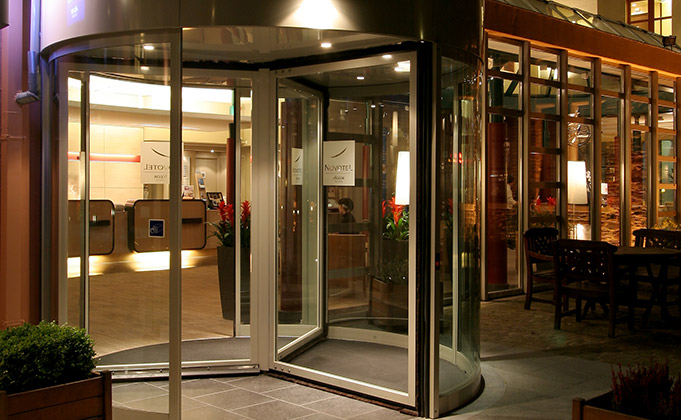
Action: Align servicing and performance validation with environmental exposure, not simply annual calendar intervals. In higher-risk or exposed sites, this may justify increased servicing frequency or seasonal testing to confirm safe operation. Environmental change does not remove compliance responsibility. It increases the need for documented oversight.
EN 16005 and risk assessment: the often overlooked requirement
Even where servicing is consistent, risk assessment remains essential because building use evolves. Where doors do not meet the latest applicable standard, ADSA guidance highlights the need for a documented risk assessment to determine appropriate actions.
In practical terms: If the entrance layout changes, the user profile changes, or incidents occur, risk should be reviewed and documented accordingly.
This is particularly relevant in:
- Healthcare
- Education
- Hospitality
- High-traffic commercial environments
- Public transport or civic building
What “good” looks like: a practical compliance approach
If you want a practical, defensible approach that works across sectors:
- Set a service frequency based on usage (not guesswork)
- Do simple routine checks and log them
- Service to manufacturer specification by trained technicians
- Record everything (logbook + remedial actions)
- Reassess risk when building use/layout changes
This is the difference between reactive maintenance and a structured compliance programme.
How KCC Group supports automatic door compliance
For organisations managing multiple sites – or even a single high-traffic entrance – the most effective approach is planned servicing supported by clear documentation, alongside responsive support when required.
A structured service plan helps you:
- Reduce downtime and disruption
- Maintain safe performance over time
- Demonstrate compliance
- Forecast maintenance expenditure
- Protect end users, staff and the wider organisation
Because automatic entrances often integrate with access control and broader life-safety systems, servicing is most effective when coordinated – not managed in isolation.

Middle East
Laidlaw Gulf are the exclusive distributor of KCC Group hardware in the Middle East
+971 04 885 7404
[email protected]
Specialists in
high performance
doorsets