KnowledgeBase
Fire Door Inspection Frequency in Ireland: A Compliance Guide
Fire Door Inspection Frequency in Ireland: A Compliance Guide
Fire doors are more than just another line on a specification drawing. They are engineered life-safety systems designed to protect people, contain fire and smoke, and preserve escape routes when it matters most.
But unlike an alarm or sprinkler system, fire doors don’t maintain themselves. They are used every day. They’re opened, closed, knocked, adjusted, and sometimes unknowingly compromised. Over time, without proper inspection and maintenance, performance can deteriorate.
In 2026, scrutiny around fire door compliance is higher than ever – particularly across healthcare, education, hospitality and multi-occupancy buildings. Documentation, competence and inspection frequency are no longer informal matters; they are central to responsible building management.
One of the most common questions we hear from architects, building owners, facilities managers and contractors is:
How often should fire doors be inspected in Ireland?
The short answer is: at least every six months in most commercial and public buildings – and more frequently in certain situations. The full answer is grounded in recognised British Standards that are widely referenced in Irish fire safety management – and understanding those standards is key to managing compliance properly.
What the Standards Actually Say
While Irish legislation places responsibility on building owners to maintain fire safety systems, inspection frequency is guided by recognised industry standards. Below are the key standards that shape what “best practice” looks like in Ireland.
BS 9999 – Fire safety in the design, management and use of buildings
- BS 9999 provides practical guidance on how buildings should be designed and managed to ensure effective fire protection for occupants.
- Section V.6.2 is clear: Fire doors should be inspected every six months for a specified list of qualities.
- This is one of the most direct references to inspection frequency and is widely relied upon across Ireland and the UK as the benchmark for routine fire door checks.
BS 8214 – Code of practice for timber-based fire door assemblies
- BS 8214 focuses specifically on timber fire door assemblies and their ongoing performance.
- Section 13.2.1 states that: Door leaves and door frames should be examined at six-monthly intervals for superficial damage, structural damage and deformation.
- In other words, inspection isn’t simply a quick visual glance. It must consider impact damage, distortion, wear and overall structural integrity.
- Section 13.1 adds an important layer: Inspection and maintenance should be undertaken by a competent person.
- That requirement is fundamental – and it has real implications for accountability.
BS 5588 – Fire precautions in the design, construction and use of buildings
- Although largely superseded by BS 9999, BS 5588 is still referenced in many existing building specifications.
- Section L.6.2 reinforces the same principle: Fire doors should be inspected every six months.
Across all three standards, the message is consistent. Six-monthly inspection is not arbitrary – it is an established and recognised baseline.

Why Fire Door Inspections Matter
Fire doors are engineered assemblies – not just door leaves. They include the frame, seals, glazing (where applicable), ironmongery, closers and latching mechanisms – all designed to resist fire and smoke for a specified period.
But they are also used every day.
They’re opened, closed, propped, knocked, adjusted and sometimes unknowingly compromised. Over time, wear and tear or minor damage can significantly affect performance.
Without regular inspection:
- Faults go unnoticed
- Compliance cannot be demonstrated
- Inspection records may be incomplete
- Insurance and audit scrutiny increases risk exposure
Inspection isn’t simply good housekeeping. It forms part of responsible building risk management.
What This Means in Practice
For most commercial and public buildings in Ireland:
✔ Fire doors should be inspected every six months
✔ Inspections must be documented
✔ Failures must be rectified
✔ Records must be retained
Six months is the recognised baseline under BS 9999, BS 8214 and BS 5588. However, it is not always the ceiling.
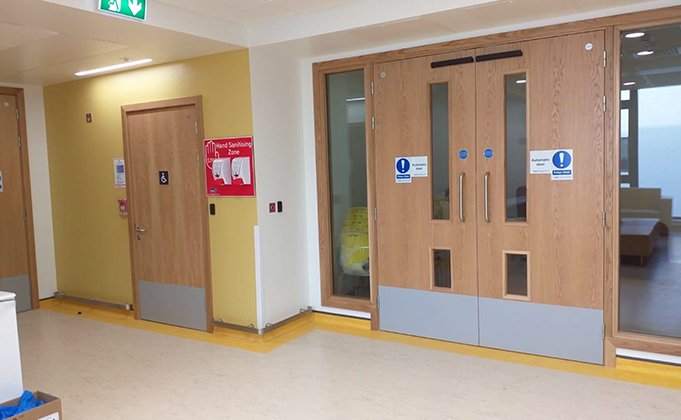
In higher-risk or high-traffic environments – such as hospitals, schools, hotels and busy office buildings – more frequent inspection is often appropriate.
Fire doors that are used heavily deteriorate faster. Closers fail. Hinges loosen. Seals degrade. Gaps widen. And none of that is visible from the end of a corridor.
Who Is Allowed to Inspect Fire Doors?
This is where compliance becomes more serious.
Under BS 8214 (Paragraph 13.1):
Inspection and maintenance should be undertaken by a competent person.
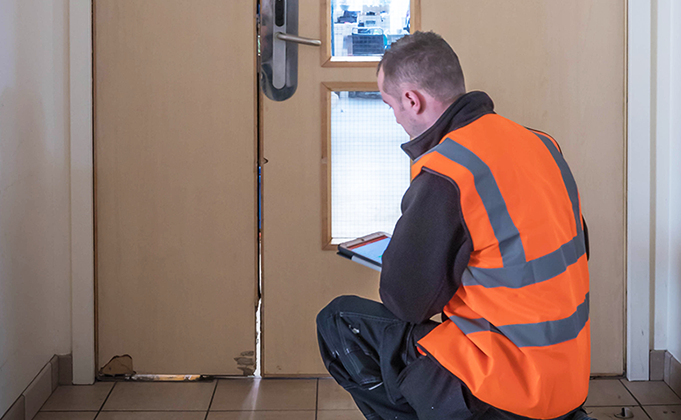
The Health and Safety Authority (HSA) of Ireland defines a competent person as:
A person who has sufficient practical and theoretical knowledge from actual experience and professional training relevant to the particular workplace and work activity.
In practical terms, that means:
- Formal training in fire door inspection
- Demonstrable experience
- Knowledge of standards and tolerances
- Ability to measure gaps and assess performance
- Proper reporting capability
In the event of a fire, the competent person may be required to provide:
- Evidence of professional training
- Inspection logs
- Documentation of remedial actions
This is not administrative box-ticking. It is legal accountability.
At KCC Group, our inspectors are accredited under BM TRADA standards, and trained to industry-recognised levels, ensuring consistent and accurate assessment.
What a Proper Fire Door Inspection Should Include
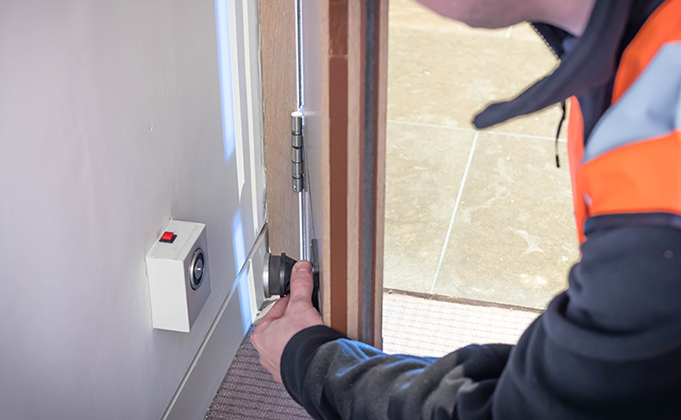
A compliant inspection involves more than a visual check.
Each door should be assessed individually for:
- Door leaf condition
- Frame integrity
- Gap tolerances (top, sides and threshold)
- Intumescent and smoke seals
- Hinges and ironmongery
- Self-closing devices
- Latching performance
- Glazing components
- Certification labels
A generic “doors checked” note in a logbook is not sufficient.
A professional inspection should generate a detailed, door-by-door report outlining findings and clearly identifying any required remedial actions.
For facilities managers and building owners, these reports form part of your compliance evidence trail.
Why This Matters More in 2026
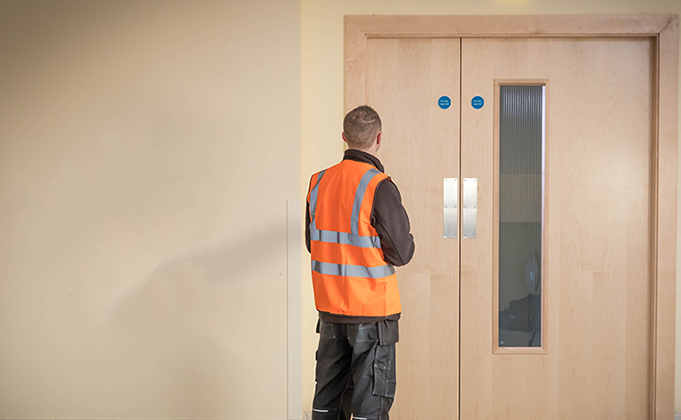
Regulatory scrutiny, insurance requirements and sector-specific audits – particularly in healthcare and education – have increased.
We are seeing:
- Greater emphasis on inspection logs
- Increased focus on turnaround of remedial works
- Closer examination of competent person credentials
- Lifecycle compliance expectations
Fire door inspection is no longer reactive. It is part of a structured compliance programme.
Integrating Inspections with with Service & Maintenance
Fire doors do not operate in isolation.
Many organisations are now integrating:
- Fire Door Inspections
- Automatic Door Servicing (EN 16005 compliance)
- Access Control Maintenance
- Lifecycle reporting
within structured Service & Maintenance Agreements. This reduces compliance gaps, simplifies record-keeping and ensures coordinated scheduling across life-safety systems.
Inspection Frequency at a Glance
| Building Type | Recommended Frequency |
|---|---|
| Commercial & public buildings | Every 6 months |
| High-traffic environments | Quarterly or more |
| After remedial works | Immediately following completion |
The standards are consistent. Six-monthly inspection is the recognised baseline under BS 9999, BS 8214 and BS 5588. But compliance is not just about frequency. It is about competence, documentation and follow-through.
Practical Tips for Inspection Planning
Here are some practical tips to make your inspection programme more effective:
- Align fire door inspections with other building safety audits
- Maintain a central log of inspection dates and outcomes
- Treat remedial works as priority items
- Retain historic inspection records
- Assign a named responsible person to oversee compliance
Regular inspections don’t just preserve compliance – they help protect the people who use the building every day.
How KCC Group Supports Compliance
In Ireland, building owners and designated responsible persons are legally accountable for ensuring fire safety measures are maintained and effective.
KCC Group provides:
- Accredited Fire Door Inspections
- Detailed door-by-door reporting
- Clear remedial action plans
- Ongoing compliance scheduling
- Integration with wider Service & Maintenance contracts
Our approach is practical, structured and aligned with recognised standards – giving building owners confidence that inspection is not assumed, but evidenced.
If you’re unsure when your fire doors were last formally inspected, now is the time to review your compliance programme.
Download our Fire Door Inspections brochure here.

Middle East
Laidlaw Gulf are the exclusive distributor of KCC Group hardware in the Middle East
+971 04 885 7404
[email protected]
Specialists in
high performance
doorsets